An intervention in South Sudan with a dual objective: to train local staff and to initiate SCT activities aimed at the wellbeing of the population and the development of skills.
The project
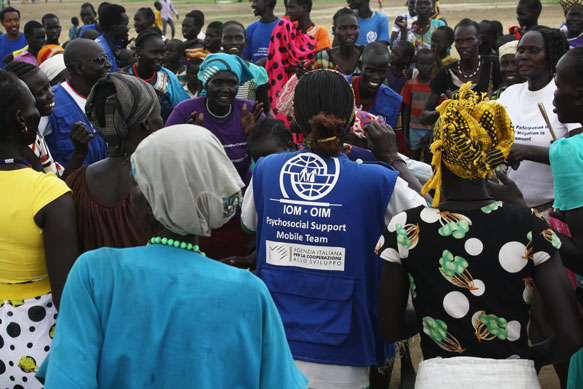
The SCT intervention in South Sudan took place in close collaboration with the Mental Health and Psychosocial Support (MHPSS) of IOM, in the Bentiu PoC, which, with 110,000 inhabitants, is one of the most populated refugee camps in the world. The intervention had a dual objective: to integrate the training of local staff and to initiate SCT activities with the population aimed at the well-being of the beneficiaries and the development of life skills.
The project was implemented through three different actions:
Context analysis and mapping of creative resources present in the PoC
Identification of targets, intervention design and implementation of TSC activities
Design, organization and implementation of the final event
Action
Context analysis and mapping of creative resources. April 28th – May 31st, 2017: the operators identified the presence of multiple activities, both artistic and supportive for vulnerable categories, already present within the PoC, carried out by the IOM MHPSS department in Bentiu. These activities are led by animators and facilitators, chosen, based on their previous skills, amongst the refugees living in the camp and whose group constitutes the IOM Mobile Staff.
The critical points identified were mainly the limited presence of new stimuli aimed at enhancing the programs of each activity and the lack of interconnections between the 5 sectors into which the camp is divided.
Following the mapping phase, SCT proceeded with the identification of targets, the intervention design and the implementation of activities.
The identified target groups were:
The Mobile Staff of the IOM MHPSS department – sector supervisors, facilitators, animators;
Young people between 15 and 25 years old, possibly those who have not yet participated in activities promoted by the IOM MHPSS department.
The intervention was structured according to different formats, appropriately chosen based on the characteristics and needs related to the various users, involving 40 beneficiaries:
Training sessions designed for the Mobile Staff, which had the objective of increasing some of the ten life skills indicated by the WHO as the fundamental core of cognitive, emotional and relational abilities, whose mastery allows one to effectively face the demands and challenges of daily life.
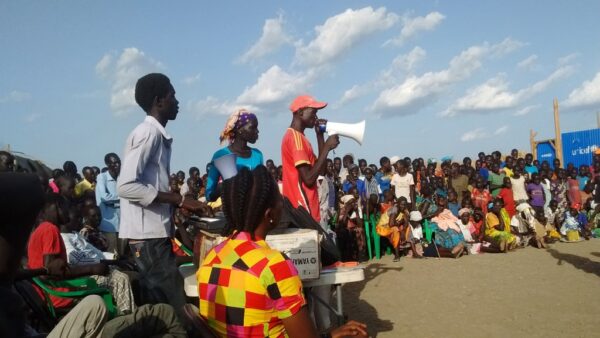
A workshop for young people, with the objective of building group bonds; fun and wellbeing; based on the theme of the water cycle – where nothing is created and nothing is destroyed, but everything is transformed – as a metaphor through whichto prepare a shared analysis regarding the need to welcome and accept the great changes in life, even traumatic ones, as an opportunity for growth and exploration of one’s resources. Compared to the planning, the working time was almost halved due to internal disorders in the camp, so a reduced cycle of meetings was conducted and it was not possible to introduce and develop the theme related to the water cycle. The three meetings allowed work on building group bonds and on acquiring the first expressive tools of theatrical language.
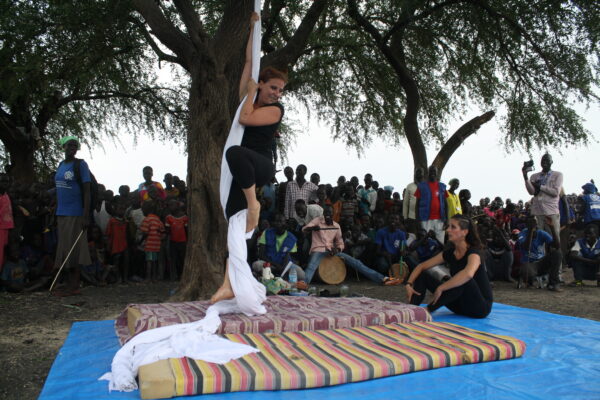
Circus open-lab, also designed for young people, conducted in a semi-structured, open-air format. This format had the objective of intercepting and engaging new users not yet involved in the activities of the IOM MHPSS department.
The social circus approach was used, which, based on the extra-ordinary use of the body and the development of psychomotor skills, is particularly attractive to a young audience.
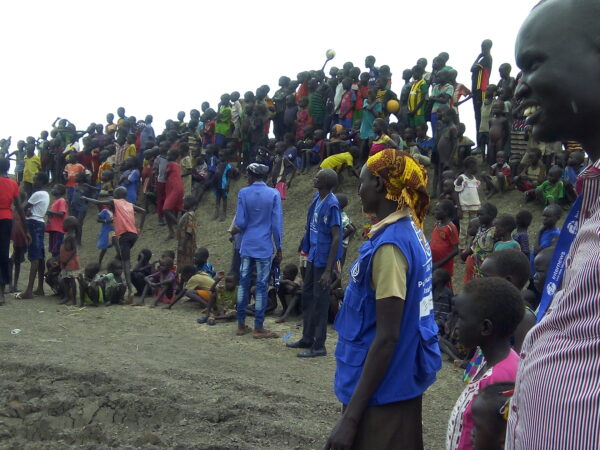
The Circus open-lab would have offered a program based on the use of two different circus disciplines: acrobatics and gyroscopic juggling. Due to internal disorders in the camp, it was possible to hold only one very well-attended meeting that attracted a crowd of about 180 people who attended and 10 boys and girls between 16 and 20 years old actively participated, experimenting with the first basic figures on aerial fabrics.
Finally, we proceeded with the design, organization and execution of the final event. The goals to be achieved with this last procedural action of the project were:
To showcase a final presentation of the work accomplished to date to the PoC community
To strengthen the community bond within the PoC, promoting exchange between the 5 sectors
To promote cooperation and collaboration processes among community members, among the five sectors, and between these and the staff of the IOM MHPSS department
To enhance the internal creative resources of the PoC
To increase the sense of belonging to the community through specific contributions
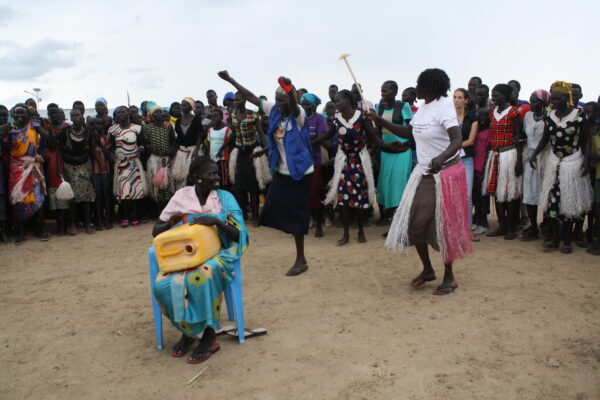
The chosen format was the Barter Parade, based on the exchange mechanism of artistic gift and counter-gift, operated with a relay system between the 5 sectors of the PoC.
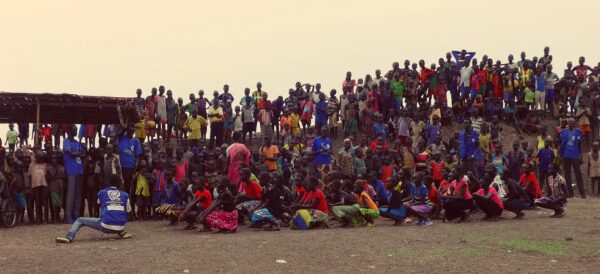
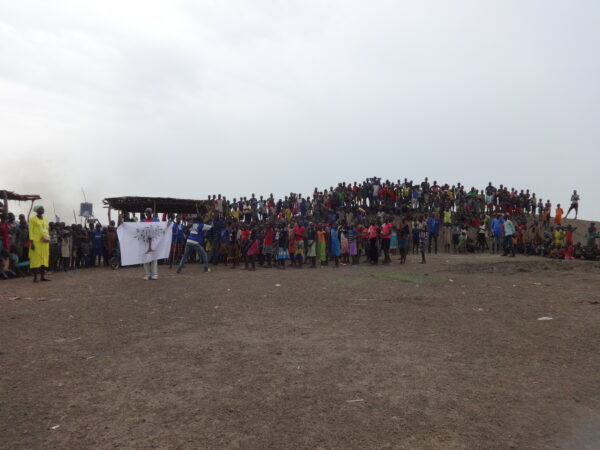
The parade was supposed to cross the 5 sectors of the camp, but due to security issues the route was scaled down, still allowing the participation of all the groups involved in the design phase. The event involved about a hundred people in its realization and saw the participation of about a thousand beneficiaries.
Partner
The SCT project in South Sudan was carried out thanks to the collaboration with the following partners:
An animated game of the goose through the languages of theater, art and new technologies, which promotes critical thinking to counter discrimination and inequality.
Skills development, employment orientation, and reinforcing the welcoming framework to facilitate the integration and self-sufficiency of unaccompanied foreign minors.
TownLAB_MEET promotes international relations between institutions and citizens from various European areas through meetings and awareness-raising activities.
A major project in the Crotone area that aims to improve the reception and integration of Unaccompanied Foreign Minors, reducing the risk of social exclusion.